
Let’s continue to explore the fascinating world of trabucchi and discover the beauty of Saracen Towers.
The private association called “La Rinascita dei Trabucchi Storici ONLUS” (The Rebirth of Historical Trabucchi) attempts to totally restore all trabucchi (stilt houses) which are present on the Gargano territory in order to boost the marine economy and tourism which characterised these territories (Puglia, Sotheastern Italy) since ancient times.
One of the most famous stilt houses on the Garganic coast is called the “Trabucco da Mimi” which is located in Località Punta San Nicola in Peschici (in the Northern part of Puglia, close to the city of Foggia).
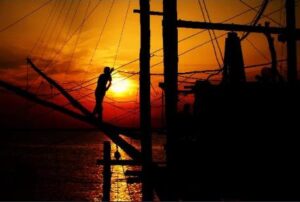
This trabucco has been used for fishing for more than 100 years and it is still used today to catch mullet fish, mackerels, sardines, anchovies, etc. At specific times of the day (like at dawn or just before the sunset) is actually possible to witness the fishermen working with the trabucco and placing the net into the water.
It is really a privilege witnessing fishermen still using a technique which is more than 100 years old.
As previously mentioned, these stilt houses can be booked by tourist and “Trabucco da Mimi” falls within this category. Furthermore, there it is also possible to taste the Garganic cousine which is based on sustainable fishing and in total respect of the envirnment.
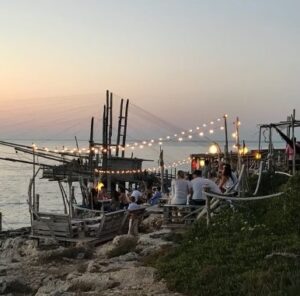
One popular option for tourists involves serving “tapas-like” local food accompanied by a nice local wine. However, the event not to miss is watching the sunset from a trabucco. The sun setting on the Southern Adriatic Sea, shades of red, yellow and orange colouring the sky and the water and the magic, unreal atmosphere created by stilt houses render these moments unique and incredibly romantic.
Other iconic structures in Gargano (Puglia, Southeastern Italy) are the Saracen towers built around 1500 AD to defend the coast against attacks from the Saracens (who are basically Turks) who were feared invaders and looters.
The building of these towers was ordered by the viceroy don Pedro Afàn de Ribera along to the building of the Vieste’s castle.
The Saracen towers got built along the coast at a relatively short distance between one another in order to have a visual connection among them. This was done in order to make smoke signals, during the day and night, easily recognizable by guards in the next tower.
It goes without saying that a smoke signals were generated to signal that an enemy ship was spotted and was sailing towards the coast.
The more signals were being generated, the more enemy ships. In other words, each smoke signal corresponded to a ship.
The towers are all squared, each side is about 11 metres (36 feet), they are approximately 12 metres tall (39 feet), they are all built using local stones and walls are usually 2 metres thick (6.5 feet).
The ground floor was used as a storage for guns, weapons and food. People would normally sleep in the first floor which was the night area of the tower while the terrace was only for enemy ship sightings.
The entire Apulian coast is characterized by these towers and, apart from the Gargano area which has 10, they are predominantly concentrated between Barletta and Monopoli (close to Bari) and Otranto and Leuca (in the southern part of the region, close to Lecce).
Needless to say that the panorama you can get from these towers is absolutely breathtaking (and it is even more so at dawn and at sunset).
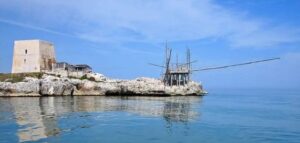
The towers which are still in existence in Gargano are the following:
-
Torre dell’Aglio (great view )
-
Torre San Felice (great view on a rocky formation called the natural arch)
-
Torre Gattarella (located inside the Gattarella Resort)
-
Torre di Pugnochiuso o della Pergola (which now is part of the lighthouse)
-
Torre di Portonuovo
-
Torre di Porticello
-
Torre Sfinale
-
Torre Montepucci
The towers which, instead, have been destroyed over the course of time are “Torre Molinella” and “Torre della testa del Gargano”.
We will expand the investigation of these fascinating towers in another article.