
Wonderful, wooden-made structures hovering between sea and sky like tightrope walkers, among beaches, landscapes, cliffs, bays, olive groves and gorses.
From these structures comes out some suggestive fishing instruments which are part of the beatiful Garganic scenario (Puglia, Southeastern Italy). These fishing instruments are a testament to the ancient traditions which contributed to enrich the local culture.
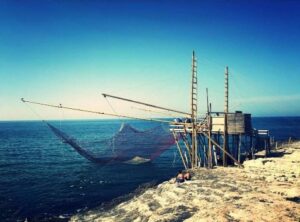
Garganic stilt hosues are an intricate frame of lines and beams but, despite that, they are incredibly stable and manage to cope with strong winds and sea storms.
The wooden poles, that are at the basis of the structures, are embedded among sea rocks and anchored to metallic lines. A complex system of antennas and pulleys allows a fishing net to sink into the waters of the Mediterranean Sea. This net gets pulled out of the sea at regular intervals to check if it managed to catch some fish.
Stilt houses (called “trabucchi”) were utilized by fishermen to fish peacefully without having the problem of sailing through the open sea where they had to face adverse weather conditions or, even worse, pirates.
The big and wide nets, in fact, were capable of intercepting the flow of fish which constantly move near the shore. Howerver, these structures were not just used as a tool, they were purposedly built also to be big enough to become a proper house for the whole family.
These stilt houses built in Puglia (Southeastern Italy) have been cited and celebrated by numerous artists in poems, paintings, songs, novels and essays.
The Italian poet D’Annunzio in his “Trionfo della Morte” (the triumph of death) cited the Garganic stilt houses: “stretched out from sea rocks, similar to a lurking monster, with its hundres limbs, the trabucco had a formidable appearance”.
A little curiosity for our readers: the name “trabucco” comes from the ancient Latin word “trabs” which means “beam” and indicates that several wooden beams that were used to build these beautiful trabucchi (trabucco is for the singular while trabucchi is plural).
The wood utilised to build trabucchi (stilt houses) on the Garganic coast (Puglia, Southeastern Italy) are predominantly the Aleppo pine (Pinus Halepensis) but also, in rare cases, chestnut trees and fir trees.
Aleppo pines grow flourishingly within the entire Mediterranean basin and its characteristics, conversely to other types of pines, renders it more enduring and resistant and this is precisely why it is primarily employed within the construction industry and shipyards.
Aleppo pine’s wood is also extremely mouldable and capable of withstanding saltiness and strong winds (which is why it is so popular when it comes to ship building).
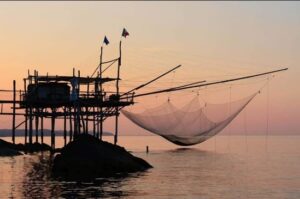
It seems that Garganic trabucchi dates back to 1240 AD, however, there are some historians who think they were invented by Phoenicians (inhabitants of the Eastern Mediterranean region we currently call Lebanon).
Unfortunately, since 1970 these structures have been progressively abandoned as people moved from the coasts to the cities or preferred to live in more modern houses. Luckily though, local authorities stepped up and in recent years and financed the restoration of some of these wonderful stilt houses, which over the years have become increasingly popular among tourists and in some cases they have become small hotels, restaurants or B&Bs (bed and breakfast).
Curious to know which trabucchi you can visit and even book for a romantic holiday? Do you want to know more about Saracen Towers? Well, jump on the second part of this fascinating article to read more