
In the previous article, we mentioned that the Mediterranean sea, at some point, might have evaporated almost completely but has this really happened? if yes, how? Keep reading this really interesting article and you will find out.
Nowadays, we all know that the Mediterranean is a landlocked sea that communicates with the Atlantic Sea (let’s forget about the Suez Canal for a second) and that’s where the water comes from.
After all, oceans and seas on our magnificent blue planet are connected with one another and, in the case of the Mediterranean, the strait of Gibraltar serves exactly that “purpose”.
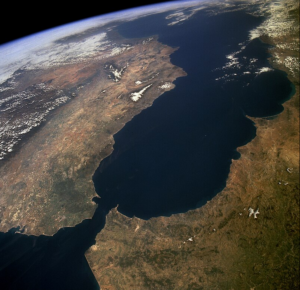
Source: NASA
Now, the Atlantic Sea is not the only source of water because there are also rivers that flow into the Mediterranean but, if it wasn’t for the water coming from the Atlantic ocean, the fresh water inflow would not be sufficient to keep the sea level steady and where it actually is.
Do you know why that would not be enough? Because the evaporation rate in the Mediterranean Sea is pretty high so the replacement ratio, which is the rapport between the amount of incoming water and the evaporating one, is fairly high and the fresh water coming from rivers would not be enough to replace all the water that evaporates into the air.
In other words, if it wasn’t for Atlantic Ocean the water level in the Mediterranean Sea would significantly drop.
Source: European Space Agency (ESO)
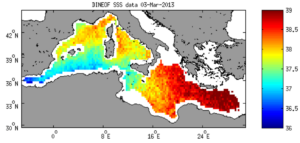
Furthermore, the evaporation rate, particularly in the Eastern Mediterranean, is so incredibly high that sends the salinity level of the sea through the roof. In particular, the amount of fresh water coming from underground basins and rivers is not enough to counterbalance the amount of water that the Mediterranean sea loses because of evaporation. This phenomenon increases the salinity of the water which in certain areas (deep red zones) can be as high as 38%-39%. In other words, the fast evaporation rate process in the Mediterranean basin causes the water to vaporize very quickly leaving the rest of the sea saltier and saltier.
Since the Atlantic is the main source of water, scientists realized that the only way to dry up the Mediterranean would be a geological event powerful enough to close the strait of Gibraltar and, according to most scientists and researchers, that’s exactly what happened.
This geological phenomenon is referred to as the Messinian Salinity Crisis (MSC) and it happened between 5.96 and 5.33 million years ago.
Source: University of Malta
The crisis was due to the fact that a shift in the geological crust, underneath the strait of Gibraltar, closed the strait itself preventing the water from the Atlantic Ocean from entering the Mediterranean basin.
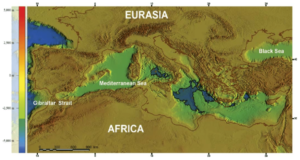
Furthermore, scientists found that, at the time of the MSC, the climate was changing and temperatures were rising causing less rains and an augment in the evaporation rate of both the fresh water carried by rivers and the sea water itself. The above reported graph shows how the Mediterranean basin probably looked like during the Messinian Salinity Crisises and as you can see the closure of the straif of Gibraltar caused the whole sea to dry up.
This provoked an initial drop in the Mediterranean Sea level which, however, later began fluctuating depending on the changes in temperatures and rains due to the instability in the climate.
However, scientists also found out that the shift in the geological crust, which caused the Gibraltar strait to shut, did not happen all at once. In fact, it appears that the crust was adjusting over time.
In other words, the crust was fluctuating back and forth causing repeated changes and several drops in the sea level multiple times.
Curious to know what happened next, discover what the MSC provoked and how the water managed to get back and re-create the Mediterranean Sea? You ought to read the 3rd and last part of this exciting story