
The religious celebration of Saint Nicholas and its popularity among Christians has deep and ancient roots, which dates back all the way to IV AD when the saint lived and was the bishop of the city of Myra in the region of Lycia (a region located in the Southwestern coast of modern Türkiye).
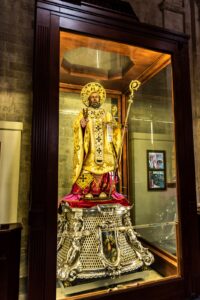
Statue of Saint Nicholas in Bari, Southeastern Italy
Saint Nicholas has been worshiped for centuries for his benevolence and his propensity to help those in need. Religious rituals celebrating Saint Nicholas are common in several corners of the Mediterranean, in particular within Central and Eastern Mediterranean countries like Italy, Greece, Türkiye and Lebanon.
Legend has it that his generosity and devotion to indigent and unprivileged people was extremely high, in fact, he used to secretly donate large sums of money to those in need without ever mentioning it to anyone.
His popularity of Saint benefactor spread rapidly and a lot of people began looking for him to get help and protection. Over the decades, Saint Nicholas began the “protector” of many categories of people such as sailors, travelers, merchants, children and also pregnant women.
In Italy, Saint Nicholas is the patron of several cities among which there are Bari, in Apulia, and Sassari, in Sardinia.
In Bari, in particular, there is one of the biggest religious ceremonies in honor of the Saint which takes place May 7-9 every year (there is a particular reason why it is celebrated in May but we will expand this in another article). This ritual is so popular and beautifully organized that attracts thousands of pilgrims and tourists from every corner of the world.
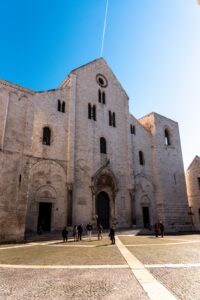
Basilica of Saint Nicholas in Bari, Southeastern Italy
During the religious feast, the statue of Saint Nicholas is carried throughout the streets of the city, accompanied by chants and prayers. It is a very emotional celebration for the inhabitants of the city of Bari, who consider Saint Nicholas as their patron and protector.
Also in Greece, Saint Nicholas is particular popular and it is called Agios Nikolaos (Άγιος Νικόλαος). As previously mentioned, the saint is considered to be the patron and protector of sailors and travelers which is why is often worshiped by seafaring people.
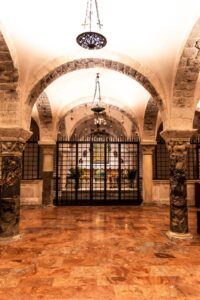
Saint Nicholas’ Crypt. This is where the bones of the saint are preserved
The official celebration of Saint Nicholas happens on December 6 and in several cities and coastal towns it consists of a religious procession out at sea where the sailors carry the statue of the Saint on their boats (in Bari is carried on caravels). These suggestive tradition recalls the fact that Saint Nicholas was the bishop of Myra, which is a coastal town.
Also in Türkiye, despite being a country where the vast majority of people are Muslim, Saint Nicholas is very popular. In fact, it is known as the name of Noel Baba, which is Santa Claus, and his religious figure is associated to generosity and goodness.
Saint Nicholas is associated to gifts and donations because the legend has it that he donated money to indigent and underprivileged people throwing golden coins through the windows of their homes. This tradition, however, is still live in Türkiye where children leave their shoes outside of their house door the night between December 5-6 hoping to find some gifts deposited inside them, the morning after.
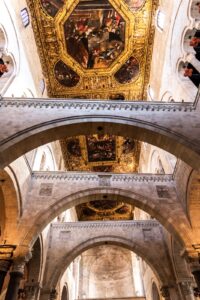
Golden ceiling of Saint Nicholas’ cathedral in Bari, Southeastern Italy
All in all, the worshiping of Saint Nicholas is a classical example of how traditions and religion may actually bring different people and cultures together.
We hope you enjoyed reading this introductory article about Saint Nicholas whose popularity managed to bring together several Mediterranean countries like Italy, Greece and Türkiye. We will expand on this and we will tell you how Saint Nicholas is actually celebrated in Bari, where his bones are preserved.