
You all know about the Mediterranean diet…but have you ever heard about…Mediterranean hair?!
Oh yes, you read it correctly!
Mediterranean hair, almost as long as Mediterranean countries’ history, definitely stronger than Mediterranean people’s will to work (ahahah), wavy like our beautiful and mighty sea and shiny like the blessed sun that shines above it.
They are usually dark in contrast to our personalities and even more clearly in contrast to our economies…but during the summer they all become lightly bleached because of the exposure to sunlight!
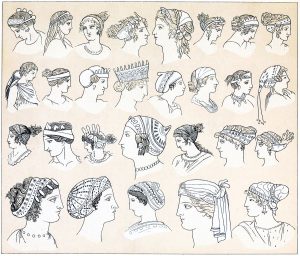
Source: www.world4.eu
In Greece, Mediterranean hair reign. From the very famous hairstyle of Helen of Troy to Beautiful Helen a well renowned figure in Greek mythology. Other very good and well-known examples of Mediterranean hairstyles belong to the goddesses Aphrodite and Hera.
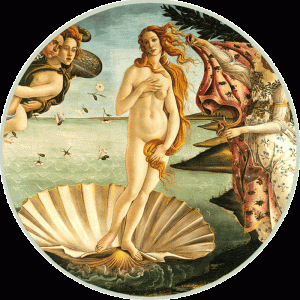
Helen of Troy, in Greek mythology, was said to have had unparalleled beauty and was a central figure in the Trojan War, her hair was one of her distinguishing characteristics that made her so appealing and underlined her pleasantness. Aphrodite, the goddess of love and beauty, is often depicted with long, flowing hair symbolizing grace and allure.
Source: www.destinationkythira.gr
Hera, the queen of the twelve gods of Olympus, is another Greek goddess associated with beauty, often portrayed with majestic long hair befitting her regal status. All these mythical figures embody ideals of beauty in Greek culture but guess what is their common characteristics besides their femininity?
You guessed it right! It’s their Mediterranean hairstyle!
In ancient Greece, hair held a significant symbolic value and various myths and cultural practices reflected its importance. Here are some aspects of the symbolism of hair in ancient Greek culture:
Beauty and Femininity: Long, flowing hair was often associated with beauty and femininity. Many female deities in Greek mythology, such as Aphrodite and Hera, were depicted with luxurious, long hair emphasizing ideals of beauty.
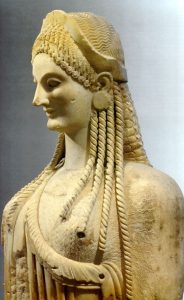
Youth and Virginity: Unmarried women typically wore their hair long as a sign of youth and virginity. Cutting the hair, especially during rituals like the nuptial haircut at weddings, symbolized a transition to married life.
Source: www.greekcultureellinikospolitismos.wordpress.com
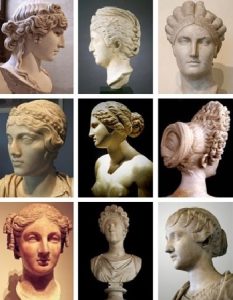
Transformation and Rituals: Hair cutting ceremonies marked significant life transitions. For example, the ritual of passage for young boys involved their first haircut, symbolizing their journey into manhood. Similarly, cutting hair during weddings represented the bride’s transition to married life. One notable ceremony was related to the cutting of hair during a woman’s wedding. Before marriage, a young woman would often wear her hair long and loose.
Source: www.blogkommoton.gr
On her wedding day, there was a ritual called the “nuptial haircut,” where the bride would cut her hair as a symbolic gesture of her transition into married life. The hairs that got cut off were sometimes offered to deities or placed in a special container. Apart from the nuptial haircut, there were also religious rituals where women might offer their hair as a votive offering to a particular deity, especially in times of celebration or supplication. While specific ceremonies for women’s hair were not as prominent as those for men, the symbolism of hair and its association with life events and religious practices was present in ancient Greek culture.
Do you want to discover what type of hair styles were there? Yes? Well, then keep reading and jump to the second part of this fascinating article!